 10-Jun-2026
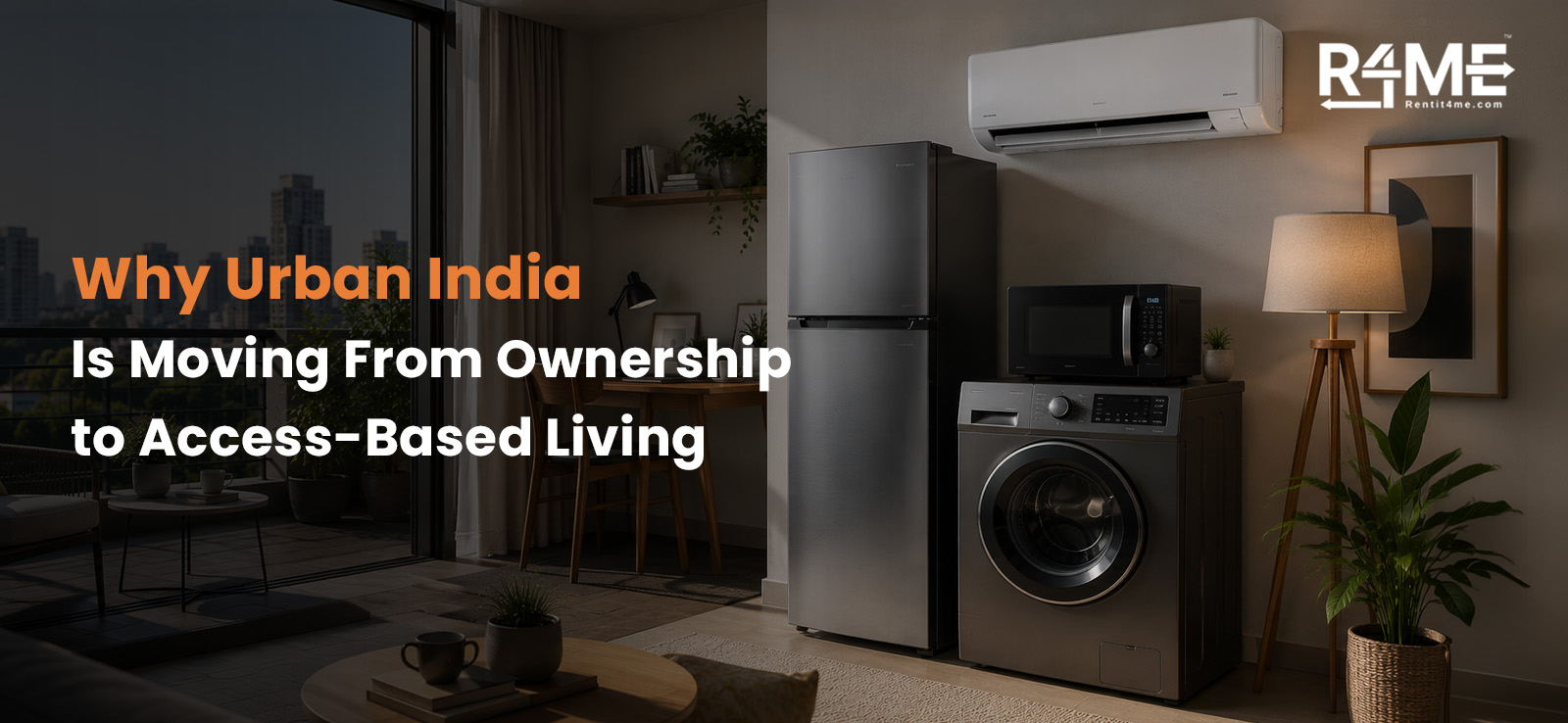
Rahul is 28. He moved from Patna to Bengaluru three years ago for a job at a tech startup. His flat in Koramangala is rented. His bike is from a monthly subscription service. He streams music instead of buying CDs. He watches movies on OTT instead of going to DVD stores. And last month, when he needed a good camera for a friend's wedding, he didn't buy one, he rented it for two days from Rentit4me.
Rahul is not an outlier. He is the face of a sweeping cultural and economic shift that is quietly rewriting the rules of how urban Indians live, consume and think about money. Welcome to the age of “Access over ownership, the philosophy that says it is smarter to use what you need, when you need it, rather than own everything you might ever need.”
From Mumbai to Mysuru, from Guwahati to Gurugram, this mindset is gaining ground faster than perhaps any other trend in Indian consumer behaviour. And it is not just about saving money though it certainly does that. It is about freedom, sustainability and a fundamentally different idea of what a good life looks like.
BY THE NUMBERS
Sources: UN Habitat, RedSeer Consulting, KPMG India
For decades, the Indian middle class dream was built around a specific set of milestones: own a home, own a car, furnish every room, fill every cupboard. Ownership was not just practical, it was a statement of social arrival. It meant you had "made it".
But the economics of that dream have shifted dramatically. Real estate prices in Tier-1 cities have become stratospheric. A 2BHK flat in south Mumbai or Gurugram easily costs ₹1.5 crore or more. A decent family car runs to ₹10–20 lakh. Furnishing a flat from scratch? Another ₹3–5 lakh at minimum. And all of this at a time when job mobility is high, careers change shape every few years and the average urban professional moves cities at least twice in their working life.
The question that a growing number of young Indians are asking is no longer “When can I afford to own this?” but “Do I actually need to own this at all?”
Consider furniture. If you're in a city for two or three years before your next transfer or career move, does it make sense to buy a sofa, a dining table and a wardrobe, then pay movers to haul it across the country when you leave? Or does it make more sense to rent quality furniture? The answer, increasingly, is obvious.
India has the world’s largest internal migration flow. Every year, tens of millions of people move from smaller towns and cities to metro areas in search of education, jobs and opportunity. According to the 2011 Census (and experts estimate the numbers are far higher today), over 450 million Indians live outside their home states.
For this mobile, ambitious population, ownership is often a liability, not an asset. Migrants need:
Flexibility to move when opportunity calls, without being anchored by possessions
Low upfront cost since capital is tight when building a new life in a new city
Zero maintenance burden because they are working long hours and don’t have time for repair hassles
Dignified comfort without waiting months to save up for a big purchase
Rental platforms are tailor-made for exactly this profile. Need a laptop for a remote job? Rent one. Need to furnish a flat on Day 1? Rent furniture. Need a washing machine or refrigerator without a ₹30,000 upfront spend? Home appliances are available on rent on Rentit4me.
“When I moved to Hyderabad for my job, I had ₹30,000 in savings and an empty flat. Renting furniture and appliances let me move in comfortably on Day 1 and pay for my things slowly from my salary. It changed everything.”— Priya, Software Developer, Hyderabad
There is a deeper philosophical shift happening beneath the practical economics. Younger urban Indians are increasingly prioritising experiences over possessions. Travelling, trying new hobbies, exploring new cuisines, attending events, these are the markers of status and identity for a generation that grew up with Instagram and YouTube.
Ownership locks you in. Access sets you free. When you own a guitar that you play twice a year, it sits in the corner collecting dust and guilt. When you can rent a musical instrument for the month you actually want to learn, you spend money only when it delivers real value.
The same logic applies across dozens of categories:
? A photographer’s camera and lens kit costs ₹1.5–2 lakh to buy.
You need it for one family event. Rent camera & lenses instead.
? Your child wants to learn keyboard for 3 months to see if they like it.
Don’t buy a ₹15,000 instrument. Rent a musical instrument and let them explore.
?️ You want to try home workouts this quarter.
Gym equipment is bulky and expensive. Rent fitness & sports equipment before committing.
? Your kids want to play the latest game console for the summer.
Gaming consoles on rent make far more sense than a ₹45,000 purchase for seasonal use.
Two of the most emotionally charged categories of spending in Indian households are children and healthcare. And both are being transformed by the access model.
When Kids Need Things, But Only For a Season
Every parent knows this story. You buy an expensive pram, a baby rocker, a crib, a high chair, all the gear that comes with a newborn. Six months later, the baby outgrows all of it and it sits in a corner of the house until you eventually give it away or sell it at a loss. Indian homes are full of expensive baby equipment that was used for a matter of months.
The smarter approach is to rent kids’ utilities from Rentit4me for this phase. You pay only for the months you need, return the item when your child outgrows it and save tens of thousands of rupees that could go toward your child’s education or experiences instead.
Medical Equipment, A Lifeline Without Ownership Burden
When a family member recovers from surgery, suffers a fracture, or needs post-treatment care at home, the list of equipment required can be overwhelming: hospital beds, wheelchairs, walkers, nebulisers, oxygen concentrators. These items cost a fortune to buy and are needed for weeks or months, not years.
Renting medical equipment is not just a financial decision, it is a humane and practical one. A wheelchair costs ₹12,000–18,000 to buy. Renting one for three months of recovery costs a fraction of that. The patient gets the care they need; the family avoids unnecessary debt.
“When my father had his hip replacement, we needed a hospital-grade bed, a wheelchair and a walker. Renting them from Rentit4me saved us over ₹40,000 and the headache of figuring out what to do with the equipment after he recovered.”— Shreya, Mumbai
India now has over 15 million gig workers and that number is growing rapidly. Freelancers, content creators, consultants and entrepreneurs make up a significant slice of the urban workforce. For this group, the traditional model of buying expensive equipment to support their work, cameras, computers, cars, tools is being replaced by renting what they need, when they need it.
A freelance videographer doesn’t need to own a ₹1.5 lakh camera kit. They can rent cameras and lenses for specific projects and price them into client costs. A remote worker who needs a powerful laptop for a month-long project doesn’t need to spend ₹80,000. They can rent a laptop or computer for the duration and move on.
The gig economy is fundamentally access-based and the tools that support it are following the same logic.
India is a land of celebrations. Weddings, festivals, puja ceremonies, birthdays, corporate events, the average Indian family spends heavily on events multiple times a year. Much of that spending goes on equipment, décor and services that are needed for exactly one day.
Think about what a typical event requires:
Generators for power backup especially at outdoor or farmhouse venues
Drones for aerial photography for weddings and events
Cameras and video equipment for capturing the moments
Sound systems and lighting for mandaps and stages
Cars and vehicles for the baraat or airport pickup
All of these are now available for rent. Generators, drones, cameras, automobiles and even event services are listed on Rentit4me. Why spend lakhs buying equipment you'll use once, when you can rent the same thing at a fraction of the cost?
There is a global conversation happening about sustainable consumption and India is at its heart. With 1.4 billion people, even small changes in how Indians consume have enormous planetary consequences. The move from ownership to access is one of the most powerful levers for sustainability available to us.
Consider the numbers. Every appliance that is manufactured generates carbon emissions, consumes raw materials and eventually becomes e-waste. India already generates over 3 million tonnes of e-waste annually and growing affluence is accelerating this. If every household that needs an item seasonally chooses to rent instead of buy, the collective impact on resource consumption and waste generation is significant.
Rental platforms like Rentit4me extend the useful life of every product. An appliance or piece of equipment that serves 5 households sequentially over its lifespan is 5 times more resource-efficient than 5 households each buying their own. This is the circular economy, not as a policy paper, but as a lived reality in Indian neighbourhoods.
This shift has been building for a decade, but several forces have converged in the 2020s to accelerate it dramatically:
1. Smartphone Penetration and Digital Trust
India now has over 750 million smartphone users. People are comfortable browsing, communicating and transacting on their phones. The friction of finding a local rental has collapsed, what once required knowing the right person or visiting multiple shops now takes minutes on a platform like Rentit4me.
2. Post-Pandemic Reassessment
The COVID-19 pandemic forced millions of Indians to reassess their spending habits. Lockdowns made people acutely aware of what they actually needed versus what they owned out of habit. The result was a post-pandemic surge in the sharing economy as people became more intentional about purchases.
3. The Cost of Living Crisis
With inflation, high EMIs and stagnating real wages for many, financial prudence has become a necessity, not a lifestyle choice. Renting instead of buying is one of the most impactful ways to reduce monthly expenses without reducing quality of life.
4. The Influence of Global Models
Indian millennials are globally connected. They see the success of sharing economy models in the US and Europe, from Airbnb to tool libraries to subscription furniture. They bring those ideas home and expect the same experience locally.
Making the shift is simpler than you might think. Here is a practical framework for the Indian household:
The 3-Month Rule: If you’ll use something for less than 3 months in a year, strongly consider renting instead of buying
The Mobility Test: If you might move cities in the next 2 years, renting furniture and large appliances is almost always smarter
The Occasion Test: If you need something for a specific event or occasion, renting is the default choice
The Try-Before-Buy Principle: Rent first for a season, buy only if you discover you use it constantly
And when you’re ready to explore the rental economy in your city, Rentit4me is your starting point, a marketplace where real Indians rent, across a remarkable range of categories.
The shift from ownership to access is not a retreat from ambition, it is a more sophisticated form of it. The smartest minds in Indian business today are building companies based on the principle that access is more valuable than ownership. Why should individuals think any differently?
Owning less does not mean living less. It means living lighter, moving faster, spending smarter and consuming more sustainably. It means your money works harder for experiences and opportunities rather than lying idle in depreciating possessions.
Urban India is not abandoning dreams. It is upgrading them. “The next decade will belong not to those who own the most, but to those who access the best.”
 Welcome to Rentit4me

